From Vitilla to Kapball: The Dominican Way to Train
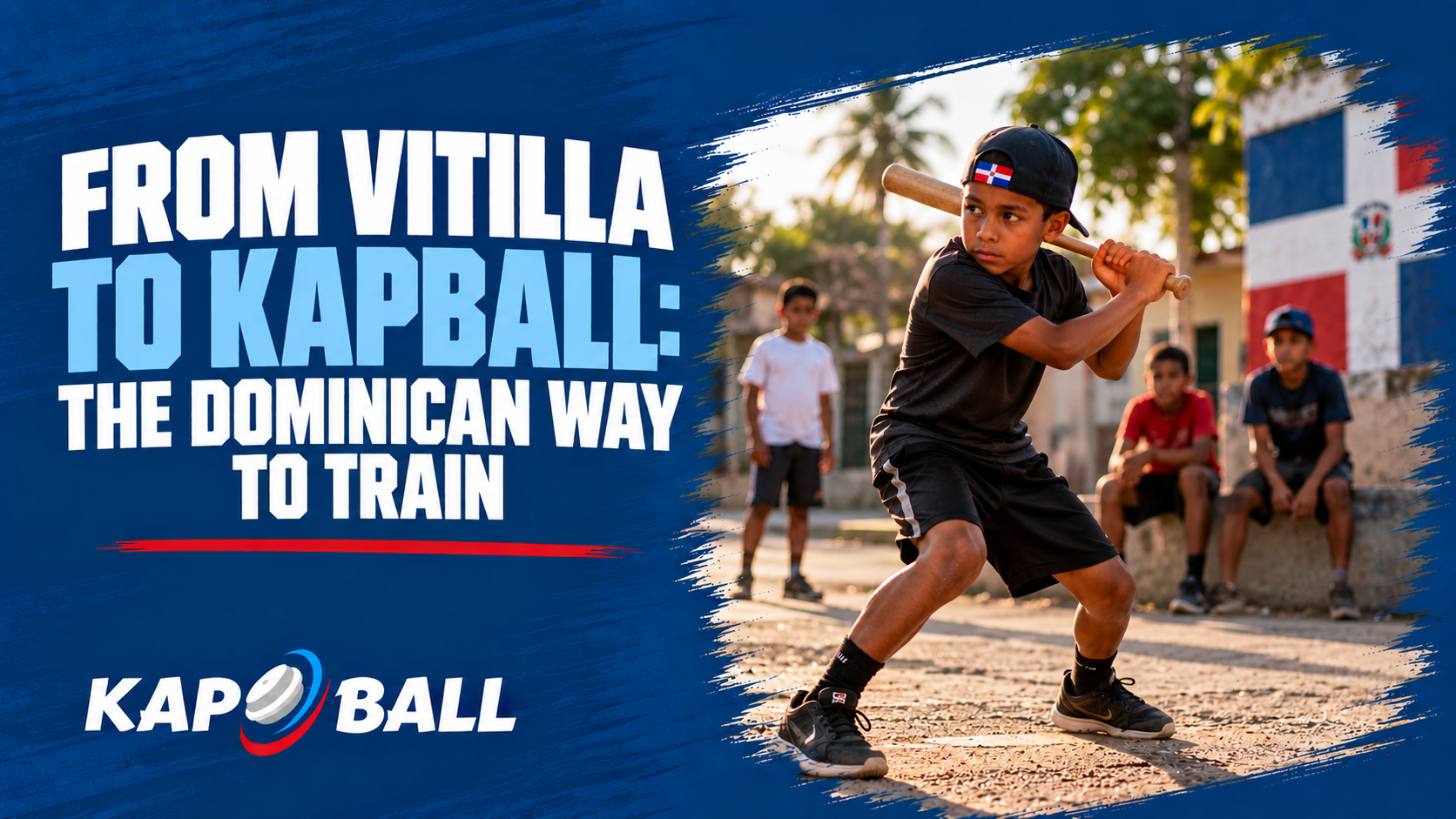
If you want to understand where Kapball comes from, you have to start in the Dominican Republic.
Before there was a Kapball bat.
Before there were specially designed Kaps.
Before there was a training system built around the idea of hitting a small, unpredictable target.
There was Vitilla.
For me, Vitilla wasn't just a game. It was part of growing up around baseball in the Dominican Republic. You didn't need a batting cage, a pitching machine, or expensive equipment. You needed a stick, a bottle cap, some friends, and enough space to play.
And without realizing it, you were training.
What Is Vitilla?
Vitilla is a Dominican street game where players hit a small plastic bottle cap with a stick.
It sounds easy.
It isn't.
The cap can move quickly and unpredictably. It can change direction. It can spin.
That forces the hitter to watch the object, react quickly, and make contact with a very small target.
Those are valuable baseball skills.
That's one reason Vitilla has become such an important part of Dominican baseball culture. It isn't simply something kids do for fun. For generations, it has been a creative way for young players to develop their eyes, timing, reactions, and coordination.
And that's where the idea behind Kapball begins. (Kapball)
I Grew Up Playing Vitilla
I grew up in the Dominican Republic, where baseball is much more than something you play at an organized practice.
It's everywhere.
And Vitilla was one of those games that could turn almost any open space into a baseball field.
You didn't need much.
You could grab a stick and a bottle cap and start competing with your friends.
What I didn't fully understand as a kid was how much that game was teaching me.
I was learning to track movement.
I was learning to react.
I was learning to stay focused.
I was learning to make contact with something small.
And I was doing all of it without thinking, "I'm training right now."
I was just playing.
The Training Was Hidden Inside The Game
That's one of the things I love most about Vitilla.
Kids don't think they're doing a drill.
They're playing.
But every swing demands attention.
The cap is small, so you can't casually watch it.
The movement is unpredictable, so you can't simply guess.
You have to track it.
You have to adjust.
You have to react.
And when you miss, you get another opportunity.
That combination creates a lot of repetitions without making the experience feel like work.
That's something I wanted to preserve.
So How Did Vitilla Become Kapball?
This is where the idea evolved.
I wanted to take the principles I experienced through Vitilla and make them accessible to more young baseball players.
The challenge was simple:
How do we take something deeply connected to Dominican street baseball and create a training tool that families, coaches, and players anywhere can use?
That became Kapball.
Kapball takes the core idea of Vitilla, a small moving target that demands focus, reaction, timing, and contact, and puts it into a purpose-built training experience.
The goal wasn't to replace Vitilla.
It was to build a bridge from that tradition to today's players.
That's why the story isn't really Vitilla versus Kapball.
It's Vitilla → Kapball.
The foundation stays the same.
The format evolves.
Train Small, Hit Big
One of the biggest ideas behind Kapball is simple:
Train small, hit big.
A regulation baseball is a relatively large target compared with a bottle cap.
When a player trains their eyes and hands to track and hit something smaller, they have to become more precise.
The Kap moves.
It's small.
You have to pay attention.
You can't get away with watching it halfway.
That forces the player to build better tracking habits and more consistent hand-eye coordination. Kapball's training method specifically emphasizes tracking early, starting with a compact swing, and building repetitions through short practice sessions. (Kapball)
Kapball Is More Than A Training Tool
This is another important part of the story.
I didn't want to create another piece of equipment that kids would use for ten minutes and then forget about.
I wanted it to be fun.
That's why Kapball can be used as both a training tool and a game.
You can work on contact.
You can work on throwing accuracy.
You can create challenges.
You can compete with a teammate.
You can play with your parents.
You can even create your own games.
That matters because kids learn differently when they're engaged.
If they want to take another rep, you've already won half the battle.
Why The Dominican Approach Works
There's something important about the way baseball develops in the Dominican Republic.
A lot of the training is creative.
You find ways to play.
You find ways to compete.
You find ways to get repetitions.
You don't always have perfect facilities.
You don't always have expensive equipment.
So you learn to use what you have.
That's not a limitation.
In many cases, it becomes an advantage.
It teaches players to adapt.
It teaches them to react.
And it keeps the game connected to play.
Kapball is built around that same philosophy.
Training doesn't have to feel like training all the time.
The Goal Isn't Just Better Mechanics
Mechanics matter.
But a beautiful swing doesn't guarantee contact.
A player can have a great-looking swing and still struggle when the ball is moving quickly.
That's because hitting isn't only about mechanics.
It's about seeing.
It's about timing.
It's about reacting.
It's about making a decision.
It's about coordinating the eyes and the body at the right moment.
That's what makes the small, unpredictable Kap so useful.
It adds a different challenge than simply swinging at a stationary baseball.
From The Streets To The Backyard
That's really what I love about the journey from Vitilla to Kapball.
Something that started as a Dominican street game can now be used by a young player in a backyard anywhere.
The player doesn't have to grow up in the Dominican Republic to experience the basic training principle.
They can pick up the bat.
Grab a Kap.
Find a safe space.
And start working.
That's the bridge.
From Dominican streets to backyards everywhere.
Preserve The Culture While Expanding The Game
I never want Kapball to erase where it came from.
Quite the opposite.
The goal is to honor Vitilla.
Vitilla is the inspiration.
Kapball is an evolution of the idea.
It's a way to introduce more players to the principles that made the original game so valuable while giving families a purpose-built, portable way to play and train.
That connection to culture matters.
Because baseball isn't just about mechanics.
It's about history.
It's about community.
It's about creativity.
It's about passing something down to the next generation.
Why This Matters For Young Players
If you're a parent, you may be wondering what any of this has to do with your child's development.
A lot.
Young players need opportunities to get better at seeing the ball.
They need opportunities to react.
They need repetitions.
But they also need to enjoy the process.
That's the lesson I took from Vitilla.
The best training doesn't always feel like training.
Sometimes it feels like a game with your friends.
Sometimes it feels like a competition with your dad.
Sometimes it feels like trying to beat your own score.
But underneath the fun, you're building skills.
And that's what I wanted Kapball to bring to the next generation.
Next Step
If your child has never experienced the idea behind Vitilla, give them a chance to try Kapball and see what happens. Don't start by worrying about how many they hit. Let them figure out how the Kap moves. Let them miss. Let them adjust. Let them compete with you. Most importantly, let them have fun. The beauty of this training style is that the learning is built into the game. That's the Dominican way I grew up with, and that's the spirit I want to carry forward through Kapball.

